Seal of Impact Nutrition
Seeking effective approaches for people, animals, and the environment
Sustainable nutrition does not result from individual measures, but from approaches that have an impact along the entire food value chain. That is why we are looking for nonprofit organizations throughout Germany that empower people, change the framework conditions, and drive innovation.
Apply for “Seal of Impact Nutrition”!
First, please fill out a short questionnaire: Click here!
Why “Seal of Impact Nutrition” is needed
What we eat has an impact far beyond our own plates: on our health, on animal welfare, and on the condition of soil, water, and the climate. Awareness of this is growing. Already, 84 percent of people in Germany say they frequently or occasionally give conscious thought to their diet.
Nevertheless, the gap between aspiration and reality remains wide: A significant portion of the disease burden in Germany is linked to our diet, and our food system accounts for nearly 30 percent of global greenhouse gas emissions. Individual consumer choices alone cannot offset this. The root causes lie in the system itself – in the way food is produced, processed, traded, and served in food service establishments.
“Seal of Impact Nutrition” highlights organizations that are tackling these issues head-on. The focus is not on what individual people should eat, but rather on which approaches effectively contribute to solving the structural challenges of our food system.
Our stance: we need interconnected solutions across the value chain
Discussions about nutrition often revolve around dichotomies: meat versus plant-based, regional versus global, organic versus conventional. From our perspective, this debate falls short.
“Seal of Impact Nutrition” does not certify dietary styles or individual foods. Instead, it highlights organizations that make effective contributions to addressing the structural challenges of our food system – at various points along the value chain and using different approaches. This is because the problems of our food system cannot be solved by individual consumption choices alone, nor by political mandates or technical innovations alone. What is crucial is the collaboration between government, business, science, and civil society. Only then can real impact be achieved.
What needs to change?
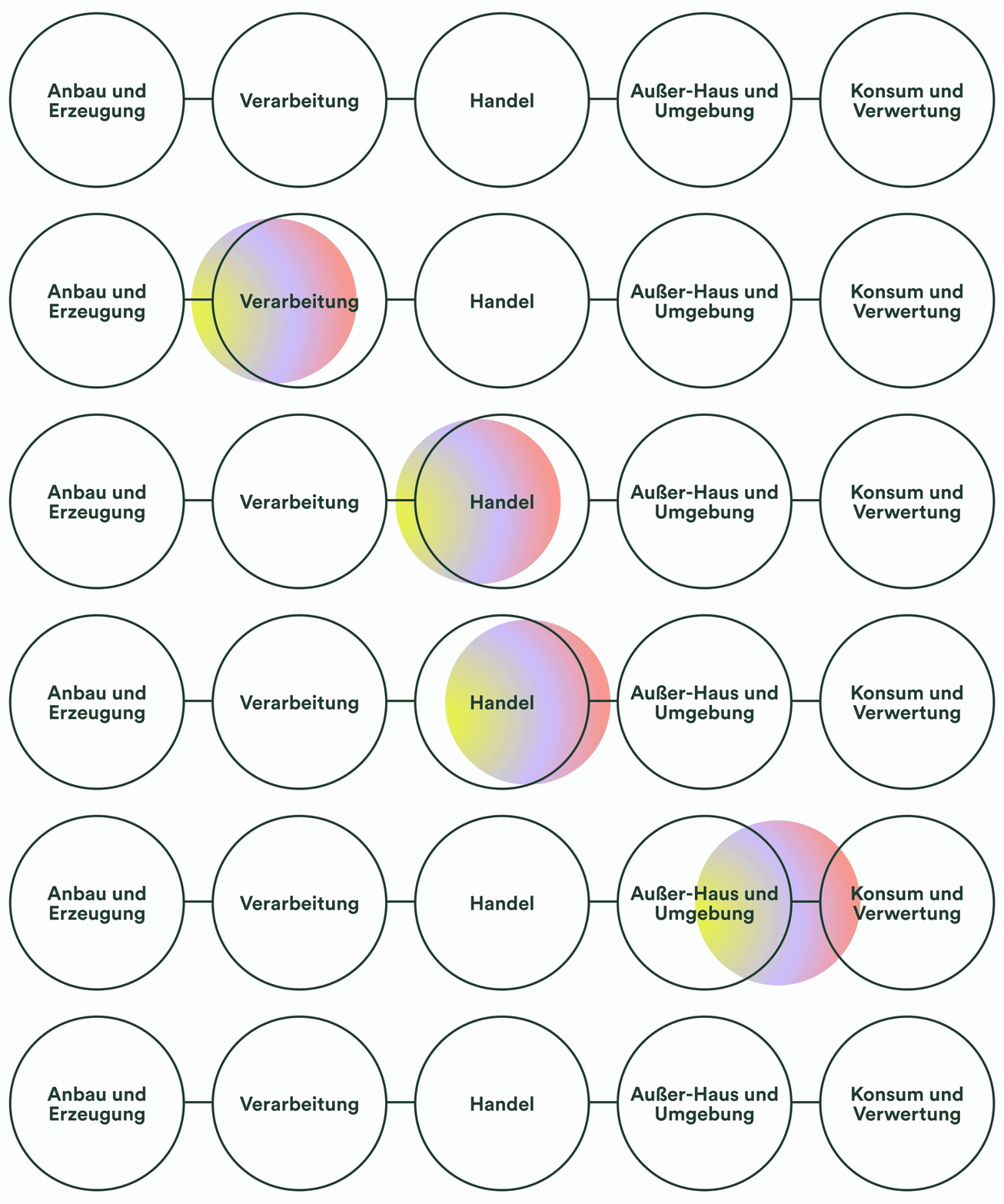
We are looking for organizations that address the issues at the very heart of our food system: along the entire value chain, from farm to table. It is not enough to focus solely on sustainability, plant-based foods, or regional products. Rather, we need a variety of interlocking strategies. This is because the goals of health, animal welfare, and environmental protection are not automatically aligned. The following three examples illustrate this tension.
Health: reducing the burden of disease
Diet-related diseases such as cardiovascular disease, type 2 diabetes, and certain types of cancer are among the most common and costly public health issues in Germany. In 2017, 52.7 percent of adults were considered overweight, and 16.3 percent were considered obese. The direct and indirect economic costs of obesity are estimated at around 63 billion euros annually. At the same time, meta-analyses show that a healthy diet can reduce the relative risk of cardiovascular disease, cancer, and type 2 diabetes by 15 to 22 percent.
This is precisely where organizations come in that strengthen nutrition education, promote prevention, and improve access to healthy food — especially in places where social and economic factors hinder this access.
Animal welfare: improving housing conditions
There is also a significant need for action when it comes to animal welfare: About 15 percent of dairy cows in Germany are kept in tie-stall systems year-round and thus have virtually no freedom of movement. A high proportion of pigs raised for meat are kept on fully perforated slatted floors without bedding. Voluntary labeling for products produced under particularly animal-friendly conditions has done little to change this so far: Only about 1 percent of meat sales in Germany come from products labeled as such.
Organizations that advocate for more binding standards, better housing conditions, or more effective labeling are helping to address a key challenge facing the food system.
Environmental protection: a differentiated rather than blanket assessment
One example illustrates how important a differentiated, evidence-based perspective is: Meat, milk, and eggs from organic farming do not automatically perform better in terms of climate impact than products from conventional production. In some cases, the opposite is even true. According to calculations by the ifeu Institute, the carbon footprint of organic beef is, on average, slightly higher than that of conventional beef. One reason for this is that organic livestock farming typically requires more land per kilogram of meat. What promotes animal welfare is therefore not automatically the most climate-friendly solution. At the same time, livestock farming accounts for more than three-quarters of the agricultural nitrogen surplus in Germany – a key cause of nitrate pollution in groundwater.
Effective approaches must take such conflicting goals into account and examine interrelationships in a nuanced way, rather than relying solely on labels or criteria.

More information about the “PHINEO Seal of Impact”
Focusing more on the middle of the value chain
Until now, the focus has been primarily on the beginning and end of the value chain, that is, on agriculture and consumers. But it is in the middle – in the retail sector and institutional food service – that what is available and taken for granted is effectively determined. For example, four retail groups now account for more than 85 percent of food sales in Germany. At the same time, millions of meals are served daily in cafeterias, hospitals, and daycare centers. Acting here changes not only individual purchasing decisions but also the conditions under which many people eat day after day.
Civil society makes a difference
Civil society organizations are not mere appendages of the food system, but rather independent, essential actors alongside the government, the private sector, and academia. The Scientific Advisory Board for Agricultural Policy, Nutrition, and Consumer Health Protection (WBAE) explicitly describes environmental and consumer advocacy groups as an important counterweight to business interest groups in food policy. Their influence is particularly evident where issues gain public attention, such as in the debate over green genetic engineering.
Numerous real-world examples demonstrate just how effective civic engagement can be: With the support of its members and donors, NABU has developed an app that allows consumers to verify the environmental credibility of food labels. Through the portal lebensmittelklarheit.de, consumer advocacy groups and foodwatch operate a central hub for transparency in food labeling and advertising. And the German Nutrition Society has, for the first time, explicitly expanded its 2024 recommendations to include sustainability aspects – supported by a growing network of civil society expert organizations.

Our message
“Seal of Impact Nutrition” not only highlights the potential impact of individual organizations for supporters. It also demonstrates the important contribution civil society makes to a sustainable food system and the role it plays in collaboration with politics, business, and science.
Who we’re looking for
We are looking for nonprofit organizations that contribute to structural improvements in the food system along the value chain – from production, through processing and trade, to consumption and institutional food service. The goal is a food system that promotes human health, enhances animal welfare, and protects biodiversity, water, and the climate. “Wirkt-Siegel Ernährung” highlights such approaches and helps funders and partners invest where their contributions actually make a difference.
Our focus is on three areas:
- Empowering people: Approaches that strengthen knowledge and practical skills related to good food, such as through nutrition education, hands-on learning experiences, or training for professionals.
- Changing framework conditions: Approaches that bring stakeholders together and improve the conditions under which people access food, for example through dialogue formats, community-based processes, or fairer access to good nutrition.
- Advancing innovation: Approaches that develop and test new solutions. These include, among other things, new value chains, circular economy concepts, or offerings that make sustainable decisions easier in everyday life.
Apply for “Seal of Impact Nutrition”!
First, please fill out a short questionnaire: click here!
The path to “Seal of Impact Nutrition“
“Seal of Impact Nutrition” is financially supported by external partners. The funding currently available can support approximately 50 analyses. Therefore, it is advisable to apply for an analysis early on. Selection takes place through a rolling application and analysis process. This allows us to allocate our internal resources optimally and continuously analyze organizations throughout the entire funding period – even during ongoing application phases.
There are 3 application phases:
- Late August — late September 2026
- Early October — late November 2026
- Late November 2026 — late January 2027
You can decide for yourself which phase you’d like to apply for. However, since the number of funded analyses is limited, we cannot guarantee that analysis slots will still be available in the third phase. This depends on the number of applications received in the previous phases.

Do you have questions?
Then email us at franka.ismer@phineo.org or sign up here for one of our online FAQ sessions (in German):
→ Session 1: September 24, 2026, 12:00 p.m.
→ Session 2: October 23, 2026, 12:00 p.m.
→ Session 3: November 23, 2026, 12:00 p.m.
More information about the “PHINEO Seal of Impact”
We’d like to thank our partners!